Wednesday, 31 December 2014

The Seven Most Anticipated Films of 2015


2014 has enveloped us in a vast variety of cinema, producing one of the film's of the decade (Boyhood), yet another melee of Autobots and Decepticons (Transformers: Age of Extinction) and a genuinely frightening horror story (The Babadook). Two of the aforementioned are hard to come by. One is not. Let us not dwell on that though, as overall I feel the epilogue for this year in film should read: a commercially successful showing for critically acclaimed cinema... and Transformers. Now to look forward to 2015. Here are my Seven Most Anticipated Films for the coming year:

7: Blackhat. dr. Michael Mann. st. Chris Hemsworth and Viola Davis. wr. Morgan Davis Foehl and Michael Mann.

Perhaps a surprising entry into my list, but what with the Sony hacking scandal being the topic of the moment, and Michael Mann back in the directors chair of a feature film for the first time in five and a half years, my anticipation for Blackhat has rapidly increased. Blackhat captures the worrying zeitgeist that plagues modern society, cyber criminality, and it follows Nicholas Hathaway (Hemsworth), following a stint in prison, helping American and Chinese authorities pursue a computerized terrorist. Sounds familiar? Die Hard 4.0 attempted to engage us with similar themes. Blackhat might have a better faring though, with Michael Mann at the helm. His last great film was Collateral back in 2004, which came after his two masterpieces, Heat (1995) and The Insider (1999). If Mann manages to inflict us with hefty drama combined with explosive action, cross-examined with thrilling tension, then we're in for a treat.
UK Release Date: 20th February 2015 

6: Jurassic World. dr. Colin Trevorrow. st. Chris Pratt and Bryce Dallas Howard. wr. Derek Connolly and Colin Trevorrow.  

I'm going to level with you. I quite liked Jurassic Park 3. Yes, it was a perforated script through rushed writing, inducing uneven characters upon the story (can you believe Alexander Payne and Jim Taylor were two of the writers?). The Spielberg touch was vacant from Isla Sorna, I'll give you that. Having said that, it was exciting enough, and Joe Johnstone did a commendable job with what he had to work with! With Jurassic World, from the trailer, it looks the closest to Spielberg's original, both in style and (hopefully) calibre. Chris Pratt has earned his stripes as an action hero with comedy chops (see Guardians of the Galaxy); give him a line and he'll deliver it with wit as razer-sharp as the dinosaur's teeth that he is running after (or from). Talking of, the stars of the show will undoubtedly be the, formerly extinct, antagonists of the piece. The reveal in the trailer was that a hybrid dinosaur is on the loose (my guess is a velociraptor/tyrannosaurus rex), and this makes for a tantalising prospect. This blockbuster will be busting the box office all summer!
UK Release Date: 15th June 2015.

5: Foxcatcher. dr. Bennett Miller. st. Steve Carell and Channing Tatum. wr. E. Max Frye and Dan Futterman. 

Bennett Miller as a director is akin to a classical composer; his previous films exude sophistication, from the acting, to the aesthetics of the set design, the costume design, the sound, the writing. In Capote particularly, there was no false note. With Foxcatcher, he appears to have exelled himself, with his distinguished style emanating from the story of mentally ill billionaire John du Pont (Carell) and his time on Foxcatcher Farm with the wrestling brothers, Mark and Dave Schultz (Tatum, Mark Ruffalo). All three male actors are being tipped for Oscar nominations, though this year in the male categories, competition is fierce. Miller meanwhile won the Best Director award at Cannes, and he will not be oblivious to Academy nominations.
UK Release Date: 8th January 2015

4: Inside Out. dr. Pete Docter and Ronaldo Del Carmen. st. (voices of) Amy Poehler and Bill Hader. wr. Michael Arndt (from a Pete Docter story).

An original Pixar. Not a sequel. With the voice talent of some of Saturday Night Live's greatest former players (Poehler and Hader), and with their latest trailer knocking side-splitting gags out of the park, Inside Out has the potential to be a Pixar classic. The story is told from the perspective of the emotions inside a little girl; Joy (Poehler), Fear (Hader), Disgust (Mindy Kaling), Sadness (Phyllis Smith) and Anger (Lewis Black). The idea of animating disparate emotions into separate living entities inside a cranium didn't have me at hello, however the first full trailer quickly evaporated any sceptical thoughts I previously had.
UK Release Date: 24th July 2015

3: Midnight Special. dr. Jeff Nichols. st. Joel Edgerton and Kirsten Dunst. wr. Jeff Nichols.

Midnight Special will be Jeff Nichols' fourth feature. His filmography thus far reads very well indeed; Shotgun Stories was an assured debut, Take Shelter for me was the best film of 2011, and Mud motivated the McConaissance. Nichols has an undivided understanding to commensurate narrative with cinematography, rather than to capsize one for the importance of the other. There are certain periods in certain films where I find a director can lose himself or herself in presenting an image on screen that has no bearing on the story. Not Nichols. He is a meticulous auteur and a creator of complete cinema. Of what we know so far, Midnight Special lands in the Sci-Fi genre, and follows a father and son going on the run after the dad learns his child possesses special powers (synopsis courtesy of IMDB). Nichols knows how to write relationships, and on this account, I feel safe in recommending this coming film to all our readers.
UK Release Date: Late 2015

2: Spectre. dr. Sam Mendes. st. Daniel Craig and Christoph Waltz. wr. John Logan, Neal Purvis and Robert Wade.

The top two previews on this list are the latest contributions to two long running franchises. Number two is Bond. James Bond. After the success of Skyfall, the momentum and expectation for Spectre has accelerated. With the first draft of the script leaked online, many now understand what the story will involve, although massive changes have surely occurred since. A cryptic message from Bond's (Craig) past sends him on a trail to uncover a sinister organisation. While M (Ralph Fiennes) battles political forces to keep the secret service alive, Bond peels back the layers of deceit to reveal the terrible truth behind Spectre (synopsis courtesy of IMDB). With Waltz winning an Oscar for one of the most despicable villains in recent memory (Hans Landa, Inglorious Basterds), I look forward to his nefarious bad guy portrayal with anticipation.
UK Release Date: 23rd October 2015

1: Star Wars The Force Awakens. dr. J.J. Abrams. st. Harrison Ford and Adam Driver. wr. J.J. Abrams and Lawrence Kasdan.

A foregone conclusion. Star Wars is the film that everyone anticipates the most for 2015. For me, the most intriguing prospect of Episode VII is Lawrence Kasdan, the man who wrote The Empire Strikes Back. Although the expectation is that no galaxy-shattering twist will be present is this particular helping, one would hope that Abrams and Kasdan have established the genesis of which a huge reveal ('I am Your Father' territory) will spawn from.
UK Release Date: 18th December 2015

A Lot of Other Films to watch out for...

- Birdman. dr. Alejandro Gonzalez Inarritu. UK Release Date: 1st January 2015
- The Theory Of Everything. dr. James Marsh. UK Release Date: 1st January 2015
- American Sniper. dr. Clint Eastwood. UK Release Date: 16th January 2015
- Whiplash. dr. Damien Chazelle. UK Release Date: 16th January 2015
- Wild. dr. Jean-Marc Vallee. UK Release Date: 16th January 2015
- A Most Violent Year. dr. J.C. Chandor. UK Release Date: 23rd January 2015
- Inherent Vice. dr. Paul Thomas Anderson. UK Release Date: 30th January 2015
- Selma. dr. Ava DuVernay. UK Release Date: 6th February 2015
- Chappie. dr. Neill Blomkamp. UK Release Date: 6th March 2015
- In The Heart Of The Sea. dr. Ron Howard. UK Release Date: 13th March 2015
- Wild Tales (Relatos Salvajes). dr. Damian Szifron. UK Release Date: 27th March 2015
- Force Majeure. dr. Ruben Ostlund. UK Release Date: 10th April 2015
- Child 44. dr. Daniel Espinosa. UK Release Date: 17th April 2015
- Avengers Age of Ultron. dr. Joss Whedon. UK Release Date: 24th April 2015
- Mad Max: Fury Road. dr, George Miller. UK Release Date: 15th May 2015
- Tomorrowland. dr. Brad Bird. UK Release Date: 22nd May 2015
- Untitled Cameron Crowe Project. dr. Cameron Crowe. UK Release Date: 5th June 2015
- Terminator Genisys. dr. Alan Taylor. UK Release Date: 3rd July 2015
- Ted 2. dr. Seth McFarlane. UK Release Date: 10th July 2015
- Ant-Man. dr. Peyton Reed. UK Release Date: 17th July 2015
- The Fantastic Four. dr. Josh Trank. UK Release Date: 6th August 2015
- Everest. dr. Baltasar Kormakur. UK Release Date: 2nd October 2015
- Spielberg Cold War Project. dr. Stephen Spielberg. UK Release Date: 9th October 2015
- Crimson Peak. dr. Guillermo Del Toro. UK Release Date: 16th October 2015
- The Good Dinosaur. dr. Peter Sohn. UK Release Date. 27th November 2015
- The Martian. dr. Ridley Scott. UK Release Date. 27th November 2015
- Mission: Impossible 5. dr. Christopher McQuarrie. 26th December 2015
- Silence. dr. Martin Scorsese. UK Release Date: TBC, Late 2015
- The Hateful Eight. dr. Quentin Tarantino. UK Release Date: TBC, Late 2015/Early 2016

Tuesday, 23 December 2014

Mini Movie Memos (and then an afterthought...)


Hobbit's come in small sizes for a reason!

The problem with this harks back to the inception of the idea in extracting a trilogy out of what is a thin volume compared to The Lord of the Rings. Monetarily, Warner Bros. will be giddy beneficiaries of The Hobbit Trilogy's Box Office returns, though I do not believe Peter Jackson did this for financial gain. This finale is the shortest in duration of the Middle Earth saga, yet is the most exhausting, due to the elongated epic proportions Jackson is intent on serving us with. The Battle of Erebor is engaging, though sadly it is not durable to losing focus, and quite frankly it is not as audacious as the battles seen in The Two Towers and Return of the King. It was prolonged and arduous, one cannot command 45 minutes of a movie with one melee of dwarves, elves, men and Uruk-Hai. Maybe there was a reason why it occupied only a few lines of Tolkien's story. There is no doubt that Jackson is a creative dynamo of cgi wizardry and a skilled translator of wonderful story-telling (See Heavenly Creatures). The problem is he tries to tell his own story. It's not all doom and gloom though! The best moments in this film come with Richard Armitage as Thorin, who, walling himself and his party in to the Lonely Mountain to ward off unwelcome guests, shows off a burgeoning contamination to his Kingship. This in no way has dented Jackson's Middle Earth Saga, which as a whole is an outstanding achievement. The final page of the Hobbit trilogy though; a spectacle, but not spectacular. 


Never trust a mystic

To a certain extent, I found myself enjoying Magic in the Moonlight. In terms of quality, all of the Woody Allen films in the past fifteen years have either found it or floundered. And here is a film that floats in between. Emma Stone (potentially the director's new muse) is quite delightful as spiritualist and possible swindle, Sophie. Colin Firth provides us with a cynical Englishman, though his place here is jarring rather than charming. The film is a whispering, whimsical and light-hearted caper. It isn't as challenging, or as good as Blue Jasmine or Midnight in Paris, but it isn't necessarily trying to be. The screenplay isn't humourless, yet there is some idle dialogue that Allen probably transcended from some of his earlier work, and tinkered with only slightly. Like I said in my opening musing though, I found myself enjoying the film. I was content with the ridiculousness of it, and the glorious setting of Southern France, along with Emma Stone (a future Oscar winner, surely) meant that Magic in the Moonlight worked for me. Instead of wondering along with a limp, it whizzed by with a couple of blisters, and I for one was fine with that. Just don't take it too seriously.

Sunday, 21 December 2014

The Seven Best Films of 2014


These films are UK releases from 1st January 2014 to the 31st December 2014

First of all, the nearly made its: American Hustle, Babadook, Chef, Dallas Buyers Club, How to Train Your Dragon 2, Ida, Life Itself, Pride, The Homesman, The Imitation Game, The Lego Movie, The Skeleton Twins, Two Days One Night.

The Seven Best

7: Interstellar. dr. Christopher Nolan. st. Matthew McConnaughey and Anne Hathaway.

Christopher Nolan might not have got all the science right. He might have forgotten to pour some cement into some plot holes. But there is no doubting that this space adventure is as epic as they come. See the full review in my Films in Discussion Post.

6: Gone Girl. dr. David Fincher. st. Ben Affleck and Rosamund Pike.

This was my film of the week when it was first released and is in my top seven for the year. The twisted Amy Dunne is an Alex Forrest of our generation, though more subdued, more conniving and more psychotic. A villain worth remembering.

5: Guardians of the Galaxy. dr. James Gunn. st. Chris Pratt and Zoe Saldana.

Guardians of the Galaxy came second in my Seven Best Marvel Films and is justly deserving of its place in this list. It is a Sci-Fi/Western extravaganza.

4: Nightcrawler. dr. Dan Gilroy. st. Jake Gyllenhaal and Rene Russo.

Nightcrawler has edge; in its cinematography, lead performance and writing. A feature on my Films in Discussion Post, it is a sublimely sadistic satire that thrills and kills!

3: The Grand Budapest Hotel. dr. Wes Anderson. st. Ralph Fiennes and Tony Revolori.

I am a huge Wes Anderson fan; his quirky style is a mainstay of modern cinema. For me, like with Paul Thomas Anderson, Wes has never made a bad film, and with The Grand Budapest Hotel, he hits the heights of The Royal Tenenbaums and The Darjeeling Limited. Deliciously exuberant, with Fiennes delivering comically observed brilliance as M.Gustave, I would throroughly recommend checking in with The Grand Budapest Hotel.

2: The Wolf of Wall Street. dr. Martin Scorsese. st. Leonardo Di Caprio and Jonah Hill.

The greatest director of modern cinema produces his funniest film to date. The Wolf of Wall Street is a wild animal on quaaludes; it is rollicking, roaring, rowdy cinema, which is energised throughout its 172 minute running time. For me, it is closest in comparison to Casino, and it plays the tables just as good!

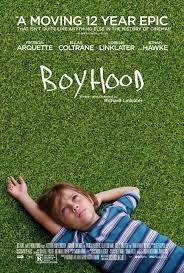
1: Boyhood. dr. Richard Linklater. st. Ellar Coltrane and Patricia Arquette.

This is one of the great achievements in twenty-first century cinema. There has been nothing like it before. Boyhood sets the bar not only for the year, but for the decade. It deserves every Oscar it gets. Linklater is the definitive backyard director, he should be the inspiration to every aspiring film maker out there. Impeccable.

Tuesday, 9 December 2014

Mini Movie Memos (and then an afterthought...)


Mustn't mention the conspiracy theories when I go see the re-release of 2001! 

2001: A Space Odyssey relaunched into cinematic orbit last week. Mostly restored in high definition by the BFI, Kubrick's enduring masterpiece is as striking and inspiring as it was in 1968. It was cultivated (as are all of his movies) for the biggest screen possible, and it was a truly magnetic experience to see it up there, as I was drawn to 2001 more than ever before. The classical soundtrack, in particular Gyorgy Ligeti's haunting 'Atmosphere's', will always stay with me. 2001 makes me proud of cinema. 


Must dance to Starship's 'Nothing's Gonna Stop Us Now', as it will be the perfect remedy to my horrible day!

The Skeleton Twins is a dark yet comically observed tale of two sardonic siblings who re-establish a bond after ten years apart, due in large to a suicide attempt. This was an undertaking of Milo (Bill Hader), a gay aspiring actor, who suffers from bouts of depression. His twin Maggie (Kristen Wiig) is married, yet takes birth control, cheats on her husband with her scuba instructor, and also suffers from bouts of depression. Suicide attempts bookend the movie, in a well-woven narrative that rivals the best original screenplays of the year. At times Skeleton Twins has unnecessary Apatow esque moments, such as a selfish young boy sticking his middle finger up to his mother, and the mother replying in the exact same manner. This is punch-to-the-gut humour, which frankly does not work here, and is nowhere near as witty as the wry back-and-forth between brother and sister. I expect both Wiig and Hader to receive Golden Globe Nominations this week for Lead Actor and Actress in a Comedy/Musical. Skeleton Twins is funny and slightly twisted, though it is equally as affecting, and its cathartic ending absolutely translates from screen to viewer.


Must give British films a chance (even if they sometimes lack superheroes, ninja turtles and transformers)

The Imitation Game is the story of a code-breaking war hero, Alan Turing, who was later condemned for being gay, and chose chemical castration (oestrogen injections) over prison in 1952. In 1954, he would go on to take his own life. He was later pardoned in 2013. It is a shameful part of our history. A story that is so important, and it is a story that has been given light on screen with meticulous direction and touching performances. Benedict Cumberbatch is a cert for an Oscar Nomination, every tremulous vocal tone and quiver of the hand describes in great depth the personality of Turing. Not just his socially-awkward exterior, but his self-doubt of his inner-self and his determination, which are exemplified in finite detail. Keira Knightley must be mentioned too, she shows Joan Clarke's journey from an uncertain girl to a composed young woman with great care and precision. In every scene she has, there is a progression, a growth, and this comes from someone who I believe is one of our best younger actresses. This is the type of film that could sweep the board at the Academy Awards, though with such a diverse year in cinema, and the plethora of quality that has come out, The Imitation Game might not win all the awards. The espionage elements involving Russian spies might have come from a quill wired up to a membrane with some creative freedom, though this film is an elegiacal outpouring of human rights, underneath the surface of the failure and success at Bletchley Park in World War Two.  

Wednesday, 3 December 2014

The Seven Best Openings to a Motion Picture

7: Touch of Evil (1958) dr. Orson Welles. st. Charlton Heston, Janet Leigh and Orson Welles.


A splendid, uninterrupted tracking shot opens Orson Welles's taut thriller. Citizen Kane is widely considered the most accomplished film ever made, due in large to its revolutionary camera composition. This sequence from Touch of Evil rivals the very best of Welles's first feature. Distinctive in its diversity of crane shots and close-ups, though all encompassed in one three minute thirty-one second take, this scene forebodes the felonious milieu and evinces the film noir setting in a commanding fashion.


6: Up (2009) dr. Pete Docter, Bob Peterson. st. Ed Asner, Jordan Nagai and Christopher Plummer.


Up's affecting opening is so simply crafted narratively. In the space of four minutes we see Carl Fredrickson meet Ellie as a child, and then how their lives become intertwined in love, marriage and heartbreak. Its emotional pull goes up and up and up, with a culmination of Ellie succumbing to old age. The montage of key events in their life together consists of harrowing elements, which include a miscarriage. Though, this is an honest portrayal of a life-story. Traumatic, yet wonderfully enlightening.

5: 8 1/2 (1960) dr. Federico Fellini. st. Marcello Mastroianni, Anouk Aimee and Claudia Cardinale.


Fellini's masterpiece begins with a dream sequence, which is ambiguous, though also very meaningful once you reach the film's end. The most outstanding aspect of it is that it feels like a dream; the jaggedness of it, the surreality, yet the array of senses being displayed making us wonder, is this actually happening? The symbolism and depth in metaphor, particularly Guido (the protagonist) being pulled back down to earth, after escaping the expectation being pressured upon  him by hanging up with the clouds, is a superb  technical feat. Above all else, this is a genuine  representation of the strain of being a director. Fellini got it right.


4: Goodfellas (1990) dr. Martin Scorsese. st. Ray Liotta, Robert De Niro and Joe Pesci.


This isn't the best scene in Goodfellas, but it is one of my favourite openings to a motion picture due to its tentative framing and editing, which intensifies the scene's content. These gangsters are going to dump a body, but when finding the body alive Joe Pesci's ruthless Tommy De Vito stabs him repeatedly in a bitter fury, and then stony-faced Jimmy Conway shoots him a few times. This in turn sways the camera to a more confident frame, introducing our triumvirate of gangsters in slick style. Then we see the figure of Henry Hill close the boot, remarking 'for as long as I can remember I always wanted to be a gangster', kicking in the rapid title Goodfellas.

3: Vertigo (1958) dr. Alfred Hitchcock. st. James Stewart, Kim Novak and Barbara Bel Geddes.


Although there is possibly Saul Bass's greatest title sequence acting as a prelude to this, the rooftop chase is seminal in its power of excitement and fear. It implies John 'Scottie' Ferguson's instability and vertigo, through the influential Dolly Zoom effect. This technique, later used in Marnie and Jaws, was so influential and perfectly represented the climax of Hitchcock's 'Veritgo', which was to reassess ones trust in a character. 


2: Once Upon a Time in the West (1968) dr. Sergio Leone. st. Charles Bronson, Henry Fonda and Claudia Cardinale. 


Once Upon a Time in the West would be one of the greatest films ever made, had it not have been for a couple of unexplained narrative jumps. Still though, the beginning is untouchable,
and the tension (my word of the day) is accelerated by the close-ups of three sweaty gun-slingers ready to take out the man getting off the soon-to-arrive train.

1: Inglorious Basterds (2009) dr. Quentin Tarantino. st. Brad Pitt, Melanie Laurent and Christoph
Waltz.


https://vimeo.com/80494528
Yes. This is my favourite opening scene of all time, a vimeo link to it is below the poster. Influenced by his Westerns, Once Upon a Time in the West being a key example, Tarantino rips open Inglorious with an introduction to the Jew Hunter, Hans Landa, and his search for a particular family in a quaint little home in France. His bilingual conversation with the home-owner is shockingly menacing, amidst the pleasantries lies an undercurrent of malice. Waltz could have won the Oscar for this scene alone! The framing is not so difficult, this scene relies on the dialogue and acting to exacerbate the fearful tension and to compound the irrevocable fate of the Jews lying under the floorboards. This is my favourite opening to a motion picture, but it could also be my favourite scene in a Tarantino movie!


My Next Seven Best Article Will Be.... The Seven Best Films of 2014!

Tuesday, 18 November 2014

Films In Discussion: Nightcrawler and Interstellar


NIGHTCRAWLER   ****          

                                         INTERSTELLAR      ****


Let's begin with Nightcrawler, a film whose lead performance is generating plenty of awards buzz in a crammed season of critically acclaimed cinema. Jake Gyllenhaal's greatest roles in previous films (Donnie Darko, Brokeback Mountain) are attributed as so because of the implicit pain felt within each character, which is only ever exemplified through subtle traits and mannerisms. Think Gyllenhaal's perennial twitch as Detective Loki in Prisoners. He is a master of character subtext, and there is plenty of this beneath Louis Bloom, the central character of Nightcrawler, though there is also something more sinister crawling on the surface. The film follows Lou, a shady yet 'ambitious' petty thief, who segues into crime journalism, which he sees as a definitive money-maker. He drives to scenes of distressing accidents, films the horror (even when irking LA's finest) and sells the footage to local TV news producer Nina (Rene Russo). In quickening his pace to these scenes, so that he can beat rival nightcrawler Joe Loder (Bill Paxton) to the hard cash on offer, he hires Rick (Riz Ahmed) as an intern to direct him to the destination, as well as being his second camera. Desperation starts to corrode Bloom's actions; he manipulates scenes as he arrives, violating police protocol and breaking the law to fan the flame of a story. From hereupon, Bloom corrupts himself to such heights, that there is nothing he will not do to stimulate his success. 
But he does not fall... the astonishment of Nightcrawler lies in the final scene, where Louis has gone on to expand his business, Video Production News, without facing lawful punishment for his culpable misconduct. Bloom is an anti-protagonist; he is, although fascinating to watch, an unsavoury lurker. It would normally be a prerequisite that a character such as himself would be driven to his comeuppance in the denouement, though like Hannibal Lecter in Silence of the Lambs, Bloom is a guilty (though not guild ridden) free man. Silence of the Lambs is an interesting comparison, Clarice Starling, an independent and tenacious young woman is toyed with by Lecter through her haunted past. Rene Russo's Nina, an older, shadier woman though with similar traits and vices, contends with the same treatment. Bloom utilises his footage as a way in with Nina, to bargain with her, to 'fuck' her. In taking her out to dinner, he manages to strip her no-nonsense demeanour, giving her an exploiting speech that proves to be efficacious. Perhaps this first swipe of manipulation forebodes Bloom's happy ending.
The creature that is Bloom is a gaunt and malnourished design of Gyllenhaal's, a scavenging hyena, though testament to the actor with his dominance in dialogue juxtaposing this meagre exterior that one would normally want to eschew contact with. Blatantly weird, he still wrangles his way around people and places with little trouble. An Oscar nomination for Lead Actor and Supporting Actress should go to Jake and Rene, with the latter reminiscent of Linda Fiorentino in The Last Seduction, though Fiorentino's Bridget Gregory would be impenetrable to Bloom's untactful tactics.
An honourable mention must go to the car chase; every vehicle on vehicle pursuit carries with it an inauspicious threat, but Nightcrawler's really is up there with Claude Lelouch's Rendezvous and Nicolas Winding Refn's Drive.
With Los Angeles so candidly observed by Dan Gilroy (brother of Tony), Nightcrawler is an honest depiction of the city's not-so-glitzy underbelly. It is a hybrid of pungent themes present in Network, Bringing Out the Dead, as well as the stylistic elements of Peeping Tom. It is a prowling and predatory picture, biting into the maniacal world of the media. It is its own movie though, and although the influences are palpable, this is highly original work. It is the anti-awards film. Dangerously funny and thrillingly toxic, it does not cry out for attention, yet it is unavoidable.


It is as easy to give Interstellar a five star review as it is to give it a three star review. Some have been amazed by the majesty of the visuals, whereas others have complained about the theoretical science and lack of cogency in the film's basic story structure. Let me first say that every point is valid, apart from critics labelling Interstellar's theoretical science as 'facile'. Because they, in themselves, are being facile. Kip Thorne's theories, which Christopher Nolan states 'could be possible', are pure speculation. I have seen reviews in which the film has been lamented for this; trust me, reviewers like this are travelling to all dimensions of stupidity. Interstellar is dynamic in its ambition, though the vibrant visuals do not obscure some fundamental flaws in the story.
A short synopsis... A team of space explorers, led by ex-engineer Cooper (Matthew McConaughey), board the Endurance and travel through a wormhole to another galaxy, to find a hospitable planet, as Earth (ruined by famine and droughts) is dying. The galaxy-by-galaxy via wormhole route is known as 'interstellar travel'.
There is obviously so much more to the film than this, but the main factor, for me, is Cooper's relationship with his daughter, Murph, as a youngster played by Mackenzie Foy, as a grown up played by Jessica Chastain, and as an elderly woman played by Ellen Burstyn. For, due to errors during the mission, the clocks on earth run much faster than where Cooper and his fellow astronauts are stationed. Thus, reversing McConaughey's famous Dazed and Confused quote to him staying the same age, and the people back home growing older. The relationship between the two is the axis on which the whole film spins on, and I do not agree with certain critics that scorn over Chastain's Murph as 'too bitter', suggesting that she should have grown out of the resentment she feels towards her father leaving. Why should she have? She is her father in many ways, plus, the fact that she and her brother are representative of Earth's last generation must be fucking frightening. Her father left her 'to save the world', he promised, but after twenty-three years, one would think that Murph has mostly given up all hope, when we first see her embodied by Chastain. Therefore, I for one totally understand this unshakable bitterness. Later on however, her hope ignites into what she foresees as fact; knowing her father to be alive, signalling her via another dimension at the films climax, how she and not he can be the saviour for posterity. And yes, the believability levels on this are quite low, but I will remind the critics who complained about this, that Kip Thorne's work is speculation, which fuels Interstellar to the Science-Fiction genre, rather than cementing it as a factual space movie. It is in the middle-ground between Apollo 13 and Star Wars. If a movie is based on speculation, it will have the components of fact and fiction, and they will both be present in the script. I digressed into ranting then, I apologise profusely. The relationship between Murph and Cooper is the film's foundation and one of its strongest assets. One can see why Mr Spielberg was the original captain of Interstellar.
I agree that the film could spend longer on Earth in the beginning, though the jump-cut from Cooper driving away to Cooper on the Endurance ready to launch is a stunning feat of film-making.
Interstellar is perhaps lacking the narrative verve and vigour that is the holding wall of The Dark Knight and Inception. It may very well be closer to The Dark Knight Rises in its somewhat tangled story-telling structure, with such issues as Professor Brand's (Michael Caine) revelation that the mission's Plan A was always an implausible feat. This was akin to punching any old jigsaw piece into a particular shaped space. It was a throw-away plot point that was thrown in. Talking of Caine's character, Professor Brand's relationship with his own daughter comes off as impassive. It is void of the emotional pull that exists in Cooper and Murph's own correlation, though I wager that it was a more felt presence in previous drafts of the script, before edits were made. Having said this, Interstellar soars as an event movie. It is revolutionary, with its Imax 70mm format capturing images that could blow even the most expansive of minds. On a visual basis, it is the 2001 of our generation.
Peter Bradshaw, whilst on Film 2014 the other week, blasted Nolan as the new 'M Night Shyamalan' and Antonia Quirke stated that Interstellar made 'Armageddon look like Tarkovsky's Solaris'. Irrational and insulting towards not just Nolan, but Shyamalan as well, these views were totally unjust (and highly inaccurate). Interstellar has a few imperfections, but hey, nothing's perfect and the wonderful thing about Christopher Nolan is, that he understands that. Though, with a filmography as diverse and beguiling as his, he will always come pretty damn close to perfect.

In my next posts I will be reviewing The Imitation Game (which I watched yesterday), discussing Richard Linklater's 'Before...' Trilogy, gifting you with my 'Seven Best Openings to a Motion Picture' and writing up the 'Seven Best Films of 2014' and the 'Seven Worst Films of 2014'. Maybe that'll start a discussion... 

Monday, 3 November 2014

My Film of the Week


GONE GIRL

Gillian Flynn's third novel about a wife gone missing burrowed into the subconscious of every couple that read it. This was a tale of danger and deceit living under the covers of a supposed loving and magnanimous marriage. Flynn's novel went on to sell over 6 million copies world wide, and it captured the attention of Reese Witherspoon, who bought the rights to turn Gone Girl's pages into images.

David Fincher, the man behind Seven and Zodiac, who is a seasoned professional in transcending nightmarish realities to screen, was the palpable candidate to find Gone Girl's cinematic potential. With Ben Affleck and Rosamund Pike in place to play Nick and Amy Dunne (the perfect couple), Gone Girl was ready to go.

Nick comes home on his fifth wedding anniversary to find a table smashed in the living room, glass on the floor and blood on the wall. His wife Amy is nowhere to seen, or found. Nick, obviously a stoic man even at the worst of times, draws suspicion from the police and media alike due to his considerable lack of emotion or expression (Affleck plays this down to a tee). With Nick now a prime suspect, as more layers of lies are peeled away, and as we see flashbacks of Amazing Amy's alarming diary entries, the male protagonist begins to suspect he is being set-up by an unlikely source. A shocking mid-film twist blows the case wide open, but does it prove Nick Dunne is innocent?

Gone Girl reminded me of the 1955 feature that inspired Psycho, Les Diaboliques, with its twisty narrative and unforgiving denouement. Talking of Psycho, the film is also an ode to Hitchcock and De Palma with its missing-person theme and a hard line of suspense running through it. Quite like Hitchcock, Fincher placates the dark hysteria of his film's subject matter with close-to-the-bone humour. The sanctity of marriage, along with Amy, goes missing, and this is something that Flynn injected into her screenplay, insofar that she is satirising that ever so blissful ideology. There is something quite false about the performances and the dialogue, and certain viewers might misconstrue this as bad and unnatural. I assure you that this is not the case; Fincher, Flynn and their cohorts are deriding the perfect marriage, and what we hear and see on screen is authenticating this, thus making the performances and dialogue all the more sinister.

This was a stroll in the park for such an accomplished director. Yet, the film itself is an accomplishment. Rosamund Pike in particular, deserves high praise and perhaps an Oscar nomination for such brave and hypnotic work. A final mention has to go to Trent Reznor and Atticus Ross's score, which contains ongoing compositions of light, ethereal music (sometimes saccharine), and an anxious, radio-static noise, akin to Ligeti's Lux Aerterna. The jumping score from upbeat to negative makes for a compelling companion to the images we focus on.

I would see Gone Girl whilst you can, before it goes missing from the cinemas.